


There’s a reason you feel more focused when someone else is in the room.
It’s not a productivity hack. It’s not a personality quirk. It’s biology — and the science behind it explains why women, in particular, are wired to thrive in the presence of others, especially when it comes to deep, sustained work.
At VIDA, we’ve built our entire VIDA Virtual virtual coworking session model around this insight. Here’s what the research actually says — and why it matters for how you structure your workday.
The Stress Response That Nobody Talks About
Most of us learned about the “fight-or-flight” stress response in school. What most of us didn’t learn is that researchers at UCLA identified a second stress response — one that appears far more commonly in women.
It’s called the tend-and-befriend response, and it was described in a landmark 2000 paper by psychologist Shelley Taylor and her colleagues. When women experience stress, their brains trigger a neurobiological cascade that includes the release of oxytocin — the bonding hormone. Rather than preparing the body to fight or flee, this response orients women toward seeking and providing social support.
The evolutionary logic makes sense: for much of human history, cooperation and community were more effective survival strategies for women, especially those caring for children, than solo confrontation or escape.
What this means practically: when women feel socially connected, their nervous systems regulate, sttress hormones drop and focus + executive function improve. The very act of being with others — even in parallel, even without speaking — activates a calming, clarifying effect that men are less likely to experience in the same way.
This is called body doubling — and it works!
What Body Doubling Actually Does to the Brain
Body doubling is the practice of working in the presence of another person — not necessarily with them, not necessarily talking, just alongside them. It’s been used informally for centuries. It’s now being studied seriously.
The mechanism isn’t fully understood, but researchers point to a few overlapping explanations:
External accountability activates the frontal lobe. The prefrontal cortex — the part of the brain responsible for task initiation, sustained attention, and follow-through — is more reliably recruited when there’s an external witness to our behavior. We don’t need that person to say a word. Their mere presence shifts us from “I should start” to “I am starting.”
Mirror neurons create social entrainment. When we observe others engaging in focused, purposeful behavior, our mirror neuron systems activate in kind. We attune to the energy in the room. Focus becomes contagious.
Oxytocin reduces threat perception. For women in particular, the tend-and-befriend response means that the social environment itself signals safety — and safety is what the brain needs to move out of distraction and into sustained attention.
Why This Matters So Much for Women with ADHD
Body doubling has become something of a lifeline in the ADHD community — and for good reason. Executive dysfunction, one of the hallmarks of ADHD, makes task initiation and sustained focus extremely difficult without external structure.
For women with ADHD specifically, the picture is even more layered. Women are historically underdiagnosed, often because ADHD in women tends to present as internalized distraction, emotional dysregulation, and difficulty with sustained independent work — rather than the hyperactive, externalizing behavior that long defined the clinical picture.
Many women with ADHD describe body doubling as the single most effective tool in their daily toolkit. Not medication, apps or timers — just: another human, present, doing their own thing.
The current understanding points back to that frontal lobe activation. When the external environment provides gentle, low-pressure accountability, it essentially supplies scaffolding for the executive function that ADHD makes unreliable. The presence of others — their focus, their presence, their rhythm — becomes borrowed regulation.
And this is exactly why VIDA Virtual sessions are designed the way they are!
Enter Ultradian Rhythms — and the 90-Minute Window
Here’s where the science gets even more specific.
Your body doesn’t maintain a single sustained state throughout the day. It cycles. Every 90 to 120 minutes, your brain moves through a complete ultradian rhythm — a biological arc from high alertness and peak focus, through a natural rest and integration phase, and then back up again.
Chronobiologist Peretz Lavie first mapped these cycles in sleep research. Subsequent work by sleep scientist Nathaniel Kleitman showed that the same 90-minute patterning that governs sleep stages also operates throughout the waking day — what he called the Basic Rest-Activity Cycle (BRAC).
What this means: you don’t have eight hours of equal focus available to you. You have a series of 90-120 minute windows, each with a productive arc and a natural completion point. Fighting this rhythm — trying to push through the rest phase, or skipping it with caffeine and willpower — accumulates neurological debt. Working with it is a completely different experience.
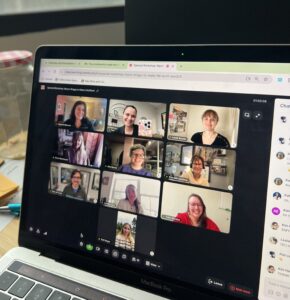
At VIDA Virtual, our sessions are structured as either 60-minute or 90-minute focus blocks, chosen not arbitrarily, but to work best biologically. During our work sessions, members join, set their intention or share their project, and work through a complete ultradian arc together. The session structure creates external rhythm for people whose internal rhythm might otherwise get swallowed by distraction, overwhelm, or the thousand other demands of the day.
The science of body doubling and the science of ultradian rhythms don’t just coexist at VIDA Virtual — they’re designed to reinforce each other. The co-presence activates focus, and the 90-minute structure honors biology. Together, they create conditions where real work — the kind that actually moves your life forward — becomes possible.
How Women Connect Differently (and Why Our Sessions Are Built for It)
There’s a substantial body of research showing that women’s social behavior is more context-sensitive than men’s. Women are more likely to regulate their behavior based on social cues, to experience emotional attunement with others in shared environments, and to draw motivation from communal goals rather than purely competitive ones.
What this wiring means for productivity is that how a community is held matters enormously. A coworking space or virtual coworking session that feels cold, transactional, or performance-oriented tends to produce the opposite of focus for women — it activates social vigilance, self-monitoring, and comparison. The nervous system reads the environment as ambiguous or subtly threatening, and protective instincts kick in.
A A virtual coworking for women environment that feels warm, intentional, and safe — one where women are explicitly welcomed, where the collective goal is contribution rather than competition, where presence is enough — that environment produces the opposite effect. Nervous systems settle. Oxytocin flows. Focus deepens.
environment that feels warm, intentional, and safe — like VIDA! — one where women are explicitly welcomed, where the collective goal is contribution rather than competition, where presence is enough — that environment produces the opposite effect as nervous systems settle, oxytocin flows and focus deepens.
This is why VIDA Virtual is, by design, a women’s space. Not because men don’t experience focus, but because women’s tend-and-befriend neurobiology is specifically activated by safe, supported social contexts. When the room feels like your room, your brain gets to work.
A Note from the VIDA Virtual Community
While VIDA Coworking offers in-person coworking at our locaitons in NE Portland and Beaverton, we launched VIDA Virtual earlier this year to help bring this thoughtful coworking model to women across all across the country. As a VIDA Virtual Member, you can expect virtual sessions available every weekday — some at 60-minutes and some at 90-minutes — built around ultradian rhythm science and hosted within a community of women who show up to do the work.
Members have described showing up to sessions when they were completely stuck, unable to start a project they’d been avoiding for weeks — and leaving having made real progress. Not because anything magical happened, but because the room provided what their brain needed: presence, structure, and the quiet signal that other people were doing hard things too.
If you’ve been working alone and wondering why focus feels like a constant battle — you’re not failing at productivity. You may simply be working against your biology instead of with it.
Learn more about VIDA Virtual and grab a free 14-day Trial →
The Bottom Line
The science is clear: women’s brains are wired to focus better in the presence of others, especially in safe, supportive environments. Body doubling works because it activates frontal lobe engagement, reduces threat response, and — for women in particular — recruits the tend-and-befriend neurochemistry that calms the nervous system and sharpens attention.
For women with ADHD, it provides the external executive scaffolding that internal regulation often can’t reliably supply. Layer in the 90-minute ultradian rhythm, and you have a session model that isn’t just socially satisfying — it’s biologically optimized.
We didn’t design VIDA Virtual around these principles because they were trendy. We built it this way because the research pointed here, and because women deserve a work structure that’s actually built for how their brains work.
Whether you’re exploring virtual coworking for women for the first time, looking for online coworking that fits around a flexible schedule, or simply craving the experience of coworking with women who are serious about their goals — VIDA Virtual was built for you, and we look forward to seeing you online soon!
VIDA Virtual sessions run weekday mornings and afternoons, plus special sessions like Ask Melanie Anything, VIDA Masterminds, Ladies Who Lunch and more. Founding Membership is $65/month (through the end of April) and includes unlimited virtual coworking sessions, community access, and optional weekly guest programming. Learn more here.