


A love letter to the MIT Living Wage Calculator — on its most relevant day of the year — and some notes on paying people enough to build a life, not just get by.
It’s raining in Portland this Labor Day weekend — the good kind of rain, the kind that makes you want tea, a blanket, and something to think about besides your inbox. So naturally, I’ve been thinking about spreadsheets. Specifically, one number I’ve been tracking since before VIDA Coworking existed: the living wage.
Back in 2018, when VIDA was still an idea and a pile of notes, I found the MIT Living Wage Calculator almost by accident. I don’t even remember what I was searching for, but I knew I was interested in crafting a more equitable pay structure for my emerging small business. When I came across this elegant calculator, I remember that it stayed with me for a long time, because it did something most economic data doesn’t — it made the abstract concrete. Not “what’s the minimum wage,” but “what does it actually cost to live here, in this county, as one adult, working full-time, with no help from anyone.” As you can imagine (and feel now, in real time, if you’re running a small business anywhere in Oregon), the gap is deep.
I decided then that when VIDA was real, and I had employees, I would pay each of them a living wage. In 2018, that meant a $20/hour floor — well above where Oregon’s minimum wage sat at the time. But the number was only part of it. I built the whole employment model around the same idea: flexible hours that could actually bend around someone’s real life instead of the other way around, paid vacation, holidays and birthdays, and some kind of saving structure (now a salary percentage contribution to a SIMPLE IRA).
It is both a values statement and also basic math: if the wage and the structure around it don’t cover the actual cost — and shape — of a person’s life, it’s hard for them to contribute to the VIDA vision with ease and joy.
What the MIT Living Wage Calculator Actually Does
The Living Wage Calculator tool comes out of MIT’s Department of Urban Studies and Planning, built under Dr. Amy Glasmeier and her team as part of the Living Wage Project. It models a full basic-needs budget — housing, food, childcare, transportation, healthcare, and taxes — for a given county or metro area, broken out by household size: one adult, one adult with kids, two working adults, and so on. Crucially, it assumes no public assistance is filling the gaps. It’s just: what does a full-time job need to cover, on its own, for a person to get by.
It’s also a living document — updated annually, and the number moves (believe it or not, every year it goes up!). Every location in the country has its own figure, because rent in Multnomah County, Oregon — where VIDA is headquartered — and rent in rural Kansas are not the same conversation.
The Living Wage Gap in Portland, Oregon
Here’s where it gets uncomfortable, in a useful way. Oregon’s minimum wage in the Portland metro area is $16.80 an hour as of this July — one of the higher state-mandated wage floors in the country. And it’s still nowhere close to what MIT’s model, or the broader cost-of-living research building on it, says people actually need.
I went and pulled the current number for Multnomah County directly off MIT’s site: $27.91 an hour for a single adult with no kids — which is about $58,000 a year before taxes, just to cover food, housing, transportation, healthcare, and the basics, with zero public assistance factored in. That’s nearly $13 an hour above the Portland metro minimum wage. For one adult raising a kid alone (my personal bracket), MIT’s model more than doubles, to over $53 an hour — an almost-impossible wage for a small business to provide.
A widely cited analysis this summer of the Portland tri-county area put the “survival budget” for a family of four above $118,000 a year — which works out to roughly $63 an hour if one person is earning it alone, or about $31 an hour each if two adults are splitting the work. And the pain isn’t evenly spread: the same research found that in accommodation and food service — the industry running half the small businesses on your block — 42% of workers are in households that fall below that survival threshold. These are the people making your coffee, checking you into your hotel, cooking your Labor Day dinner reservation.
Why This Matters So Much for Small Businesses in Oregon
And in Oregon, more than almost anywhere else, those people are working for small businesses like mine. According to a recent Oregon Employment Department report, nearly 40% of the state’s private-sector workers are employed by firms with fewer than 50 people. There are over 110,000 small businesses like that in Oregon — more than nine out of every ten businesses in the state — and together we employ a disproportionate share of the workforce compared to the rest of the country, where roughly half of all workers are concentrated at large companies with 500-plus employees.
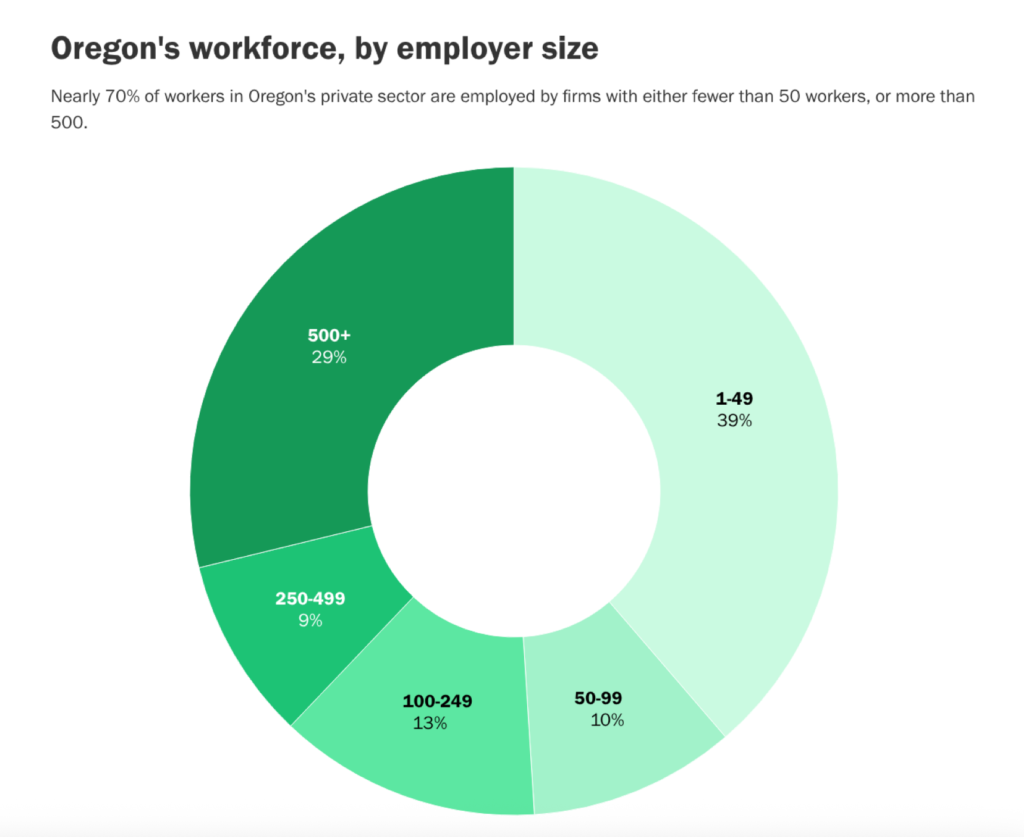
Oregon just doesn’t have that many corporate giants. It has a lot of us: coffee shops, salons, yoga studios, small hotels, family restaurants, and yes — coworking spaces. Which means the living wage conversation in this state isn’t really about a handful of big employers deciding to do the right thing. It’s about tens of thousands of small business owners, one payroll at a time, trying to figure out how to make it work.
This is a big part of why I built VIDA as a Portland coworking space in the first place. Small businesses and independent workers hold up so much of this state’s economy, and a community-driven coworking space is one small way to make that work a little more sustainable — for owners and for the teams they’re building.
Why I Keep Coming Back to This
While I was doing research for this post, I realized that the living wage figure had moved — as it does most years — since I’d last checked it, and one of our team members’ pay was no longer a living wage. So I adjusted their pay to match. It wasn’t a negotiation, just part of how we operate: when the real number changes, we change with it. It’s a small, unglamorous, recurring task — and an increase in overall company expenses, which I don’t take lightly. But it’s also, I think, the actual point of the whole exercise.
Paying a real, current living wage has been good for VIDA in every practical sense: lower turnover, people who can truly enjoy their jobs, and a team that isn’t quietly job-hunting because rent went up again. “Make Life/Work” isn’t just a nice phrase for me — it’s the actual design constraint. If the wage doesn’t let someone build a life, the work isn’t working.
But zoom out far enough and this is really a question about what kind of system I want to be part of. Wealth and profit get distributed somewhere in every business — to shareholders, to owners, to reinvestment, to the people doing the work. Choosing a living wage is choosing to route some of that distribution toward the people on your team, deliberately, as a matter of design rather than an afterthought. It’s not the only way to build a stable, equitable business, but it’s the one I picked, and I am proud of it.
What the Holiday Was Actually For
It’s worth remembering, on a weekend that’s mostly become about mattress sales and the unofficial end of summer, that Labor Day didn’t start as a day off… it started as a protest!
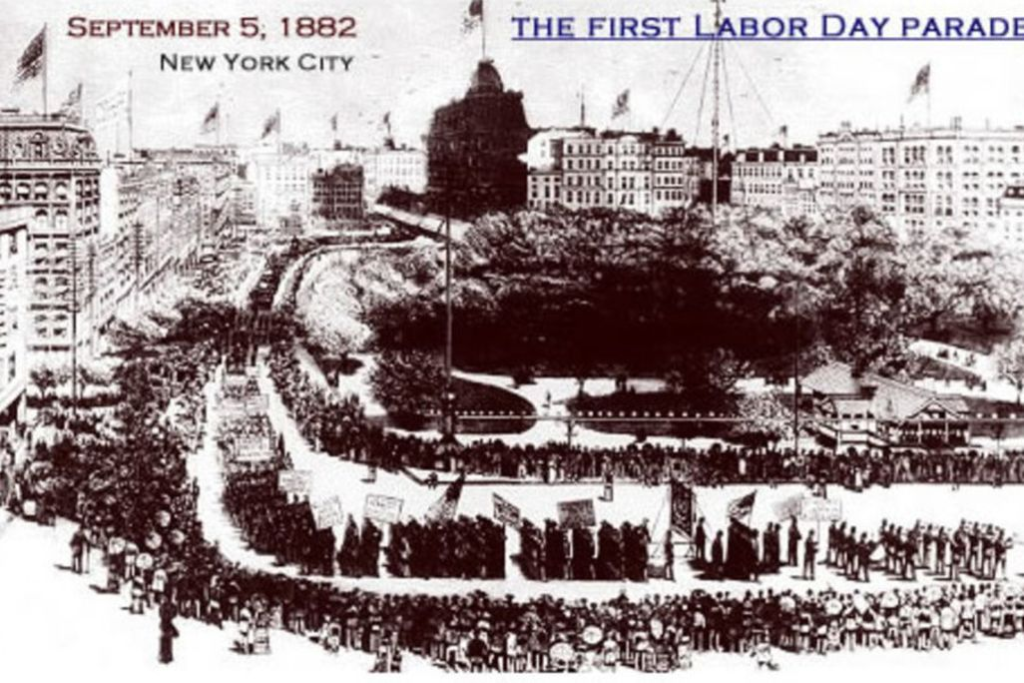
The first Labor Day was a parade in New York City in 1882, organized by the Central Labor Union — workers marching, unpaid, on a Tuesday, to demand shorter hours and better conditions. It took over a decade of pressure, strikes, and organizing across the country before it became a federal holiday in 1894. And it became one, pointedly, in the aftermath of the Pullman Strike — a national rail boycott that turned violent after federal troops were sent in to break it, leaving workers dead. Congress made Labor Day a national holiday just days after that strike ended, widely seen as an attempt to smooth things over with an angry labor movement.
So the holiday’s origin story isn’t really about barbecues and the changing of the seasons. It’s about workers insisting, loudly and at real cost to themselves, that their labor deserved to be worth something concrete — decent hours, fair conditions, a wage that meant something. That’s the same question the living wage calculator is quietly asking, over a century later, just with better data. What is a day of someone’s work actually worth, here, now, exactly where we live? The fight looks different — spreadsheets instead of strikes — but it’s the same fight.
That question has an old answer, too, one I think about a lot. In 1912, Theodore Roosevelt gave a speech to the Progressive National Convention attempting to define what a living wage actually meant, and his definition wasn’t really an economic one — it was a moral one. He argued a living wage should let workers secure a normal standard of living, one that made room for education, recreation, child care, a cushion for sickness, and something set aside for old age. Not survival, but a life.
That’s a much bigger ask than “covers rent,” and I think it’s the right one. A wage isn’t just a transaction for hours worked — it’s a statement about what kind of life a business believes its people are entitled to build.
A Labor Day Nudge for Portland Small Business Owners
If you run a business in Portland or anywhere in Oregon — coworking space, coffee shop, agency, whatever it is — I’d genuinely encourage you to go look up your own county on MIT’s Living Wage Calculator this weekend. Mostly just to see where you stand with wages… you might already be there, or at least closer than you think. Or you might find, like I did in 2018, that there’s a number worth building around.
As with most aspects of running a small business, paying a living wage might not be easy to do, and the funds to do it might not be there for a while. But it is an achievable goal, and in the long run it will certainly pay off for your business, its employees, and your community.
And if you’re reading this as someone who earns a wage rather than sets one: it’s worth knowing the real number for where you live, too. Not to feel bad about it — just to know what you’re actually up against, and what “enough” really means in your zip code, and to see if there is a conversation to be had with your employer.
Because all of our contributions are important to our society, our communities, and our families. Happy Labor Day, all — thanks for your contributions, and here’s to a fair, living wage for each of us.

VIDA Coworking is a boutique coworking community with locations in NE Portland, Beaverton, and coming soon to NW Portland. Founded in 2019 on the belief that small businesses can build sustainable, equitable workplaces — starting with how they pay their people, VIDA continues to Make Life/Work for our team, members and the communities we serve. Learn more about VIDA membership or come tour our spaces to see what we’re all about!